BIPFAMILAll submissions for this problem are available.In this problem, we study about Range Graphs - a special family of bipartite graphs. A bipartite graph with $n$ vertices on the left part (numbered from 1 to $n$) and $m$ on the right part (numbered from $n+1$ to $n + m$), is said to be a Range Graph, if each vertex on the left satisfies the following property - the numbers of its set of neighbors should form a consecutive range/segment on the right.
For example, suppose $n$ = 10 and $m$ = 13. Then the vertices on the left are {1, 2, …, 10} and the ones on the right are {11, 12, …, 23}. Now, suppose the neighbors of vertex 7 were {12, 14, 15, 19}, then this would not be a Range Graph, because they aren’t consecutive numbers. So for it to be a Range Graph, the neighbors could potentially be, say, {12, 13, 14, 15}.
Your task is to find the total number of connected Range Graphs which have $n$ vertices on left and $m$ on the right. Output your answer modulo $10^9 + 7$.
Note that two Range Graphs are considered to be different if there are two vertices i and j such that one of the graphs has an edge between them, but the other graph doesn’t. In other words, the edge set should be different. A graph is said to be connected if every vertex is reachable from every other vertex through some sequence of edges.
Note: The source limit (ie. the size of your program file) for this problem is lower than usual. It is 10 KB.
###Input
###Output: For each test case, output an integer corresponding to the answer of the problem.
###Constraints
###Sample Input:
2
1 2
2 2
###Sample Output:
1
5
###Explanation Example 1: There is only one possible connected Range Graph with one vertex on the left and two vertices on the right. It will have an edge between vertices 1 and 2, and also between vertices 1 and 3.
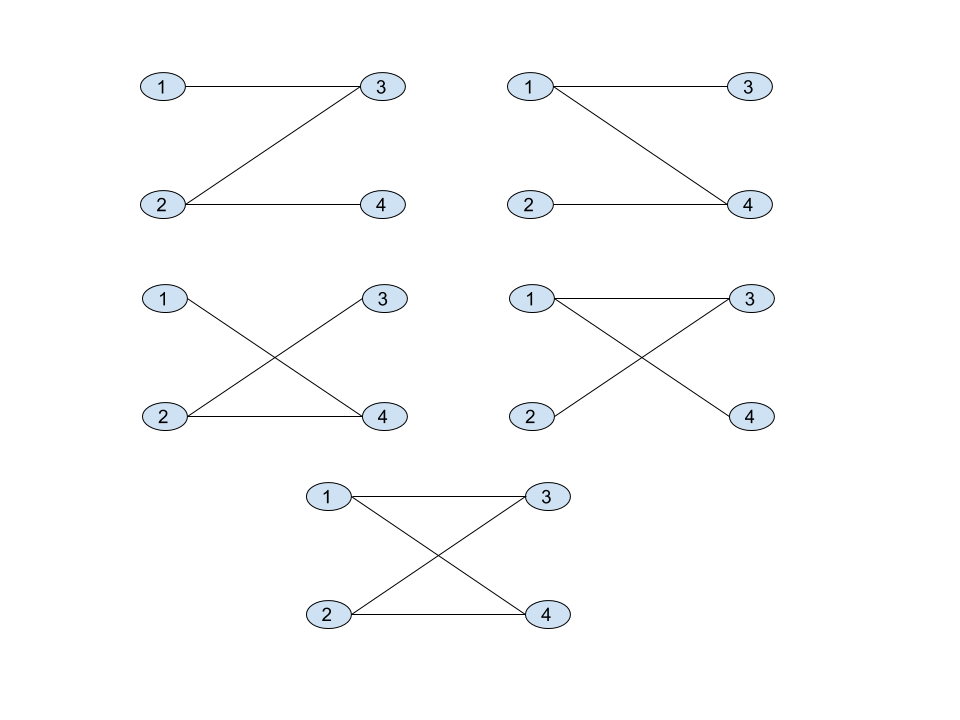
Example 2 Here are the five possible connected Range Graphs with 2 vertices on left and right: